

Red, Red, Nazi Hunter
Who knew she was a heroine of WWII ?

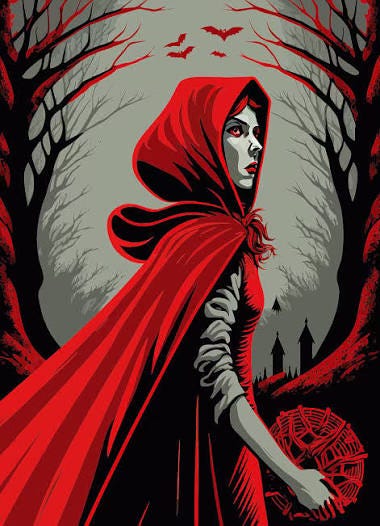
Here is another fairy tale, dear readers. Let me know if you want more.
“What’s wrong with her?” Those were the first words my mother said about me. The neighbor woman who had come in to help with the birth just shrugged. “Nothing.”
I had two eyes, two arms, two legs and I was crying. So, what was wrong?
“On her head,” my mother said, half sitting up, pointing.” What is that?”
The woman laughed. “Her hair. It’s red.”
“How can that be?” My mother’s hair was blonde. My father’s hair was blonde. My three brothers and two sisters were blonde.
The woman shrugged, rolling up the rags, pouring out the water. “But nobody has red hair,” my mother said. That was true. Not in our village. Not in the next village. “It’s ugly. Horrible”
“She can wear a cap. Make her a cap,” the neighbor woman said, “When she is older a shawl, maybe, or a hood. Nobody will notice. But start with a cap. “
“A cap?” my mother said.
“You know like that peddler wears,” said the neighbor woman, trying not to smirk.
Once a year a peddler came to the village. He sold thread, pins, and pieces of cloth. He had red curly hair and green eyes and wore a little black cap on the top of his head. He told jokes and made the women laugh. A Jew.
My mother screamed. “No, no!” and I screamed too while the neighbor woman just laughed and took her rags and left, slamming the door.
The next day my mother got out of the bed and walked to the river near the village and threw herself in. It took days to find her body. My father, a practical man with six children, married the neighbor woman. She fed me goat’s milk and made me caps and bonnets and then a little red hood that almost completely covered my red curly hair.
I knew I was different but not that different. I played with my brothers and sisters. I went to school and did what I was told. I knew I shouldn’t stand out and so I didn’t stand out. I prayed every night and went to church on Sunday. I felt I was waiting for something to happen, but I didn’t know what. I told myself I should just be quiet and wait.
We all knew there was a witch who lived in the forest, so hidden away that there were no paths to her house. She was a witch, certainly, and maybe worse, a demon or a sorcerer. We knew that the Bible said we should not let a witch live, but everyone was afraid. Once or twice a young man from the village, and once or twice a young man from the neighboring village, brave and foolish had gone into the forest to find her, to kill her we thought, but had never returned. Of course, there were wolves in the forest too. But we knew it was the witch. The priest did not talk about her. How could he? She had the power to make us afraid. But only God was supposed to have the power to make us afraid. The priest kept quiet.
I was almost 16 when the peddler came back. Maybe it was the same peddler or a different one. I wasn’t sure. He wore a black cap, and his hair was a little red in places but mostly gray. He was very, very thin. “Things are bad for my people,” he told my father who nodded but shrugged. “We don’t want anything,” said my stepmother shooing him away.
I knew I shouldn’t, but when no one was looking I followed him to the edge of the village. I didn’t think he noticed I was behind him, but he turned suddenly and caught my arm. “So, it’s you,” he said. I couldn’t answer. “There’s an old woman who lives in the woods. Do you know who I mean?”
“The witch.” I whispered, shaking.
“Go visit her. She’s your grandmother,” he laughed and was gone.
I waited for days, for weeks, for months. I was almost 17. My stepmother wanted me to marry the son of the goat herder. Since she had fed me goat milk maybe she thought I was already part of the family.
The goat herder’s son came to sit with me. He was tall, thin but he didn’t talk much. We sat together in silence. This wasn’t what I was waiting for.
One day I was making bread, three loaves. I left two cooling on the table and put the third in a basket, covering it with a cloth. I was wearing my hood. I always wore my hood, and I put on my warm red cape. Everyone was busy. My father was in the field. My stepmother was talking to a friend. My brothers and sisters were scattered around, doing their daily chores. No one noticed when I walked to the edge of the village and stepped out on the only path. I was alone. Soon I was hidden by the tall dark oak trees. I felt brave, maybe more myself than I had ever felt before. Was this what I had been waiting for?
I walked on and on and it got darker and colder. The path ended but there was an even narrower overgrown path that I was able to follow. I could hear some sounds. Was it the wolves? But then suddenly a man was standing before me. Big, and heavy, wearing a uniform that I had never seen before. He had a long coat, a helmet, and a rifle. He came towards me, speaking a language I didn’t understand. He seemed to be smiling, showing long dark teeth and then he was on me. I tried to push him away. He was biting me, my neck and my breast and pulling at my clothes, my skirt, and my underpants. I tried to fight. I tried to scream. He pulled my legs apart. And though I kept fighting and crying I knew what was going to happen. But then a shot and then another. I knew the sound. He slumped over me, his hands suddenly still. I began to feel blood seeping into my dress.
“Can you get up? Try to get up,” she said in a quiet calm voice. I struggled from under him, scratching my back on the branches I was lying on. I was dirty, bloody, sore. I went to pick up my basket and the bread lying in the dirt. “No,” she said, “grab his leg. Hurry.” At that moment I know I should’ve wanted to go home, back to the village, back to safety but I didn’t. It was the witch, and I did what she told me to do.
We dragged him for a long time to the cottage, her cottage, so very deep in the woods. He was heavy and my arm hurt. “In the back,” she said. “The wolves should take care of him in a couple of days.”
She gave me water to wash, gave me a shirt and a pair of soft pants. I had never worn clothes like that before. She laughed when I took off my hood and my long, red, curly hair flowed down to the middle of my back. The back of my hood was soiled.
“I remember hair like that,” she said. “Give it to me,” she said and took the hood. “Now go to sleep. You need to sleep,” she indicated some pillows by the fire. I lay down and closed my eyes. I did not want to think about what had happened. She moved around and then finally sat nearby on a rocking chair, smoking a pipe. She looked like a little old woman, not a terrifying witch. But then I remembered she had shot the man who was attacking me, not once but twice.
In the morning two young men came to the cottage. They looked familiar. They were the young men from the villages who had gone away. “What is she doing here?” one said, sounding angry. The witch shrugged. “Come outside. We need to talk.”
I watched them through the little window. She pointed to the half-eaten remains of the soldier. One kicked the helmet and part of his skull fell off. They whispered together for a long time as if they were arguing. Finally, the bigger one, the taller one who I remembered the most from my village because he was handsome, and everyone had thought he was smart, shook his head as in agreement and they came back inside.
“Here’s the plan,” he said. “You lure them. We kill them.”
“What are you talking about?” I stood up. I knew they were looking at my body under the soft boy’s clothes.
“The war, stupid. Don’t you know anything?” The handsome one said. He did the talking. “The Nazis.”
I tried to remember. Months ago, my father had said something about soldiers to my stepmother. But then he said they won’t come here. There are no Yids.
“We are partisans,” the handsome one said. “Communists,”
“Reds,” the other one said finally with a laugh. “Like you. Are you red all over?”
The witch reached up and slapped him hard across the face. “Don’t talk dirty,” she said. He slunk away with his head down but did not protest. She went to the stove. “First, I make soup. Then I will make your explosives.”
She gave me my dress back and somehow made me another to wear. I learned fast. I lured them. They shot them. It was the plan. Sometimes before they raped me or while they raped me. When there was two or three after at least one had raped me. We wandered through the forest and sometimes even went into the nearby towns.
The handsome one whose name was Peter became my lover. But he didn’t seem much different to me when he fell on me and moaned than the soldiers. The other was called Jan. He watched. We became famous. People talked about us. We counted kills: 27, 32, 39, 51.
The two men went off sometimes by themselves to meet other groups, to blow up a bridge, to steal more weapons. I stayed with her. We didn’t talk much but we were comfortable together. I worried about getting pregnant. She seemed to know. She gave me something bitter to drink that burned my throat and burned going down. It always made the blood come.
I asked her to teach me her spells. She shook her head and said she didn’t know any. She tended a garden and fed the animals with scraps, even the small wolves that prowled around the door and sometimes circled her feet. She could even pet them. “Wolves kill to eat,” she said. “Men kill to kill.” Once a week she lit candles and prayed over them, muttering in a strange foreign language. I liked to watch. One summer night I woke up and the door was open. I went to look, and she was outside, surrounded by the wolves. The biggest one was as tall as she was, and his head was close to her. She was stroking him and murmuring. I wanted to cry out but stopped. But in the morning when I thought about it, I wasn’t sure it hadn’t just been a dream.
Peter, Jan, and I went away for a long time. There were soldiers to find and soldiers to shoot. I worried about her alone in the woods. Yes, she was a witch and people had been afraid, but I had seen terrible things, starving children, men being shot and screaming, falling into pits, women crying as their babies were bashed against walls. Far more terrible things than any witch would even want to try to make happen.
Weeks later, going back to the cottage, we knew something was wrong. The path was wider as if too many boots had broken the branches and trampled the dry leaves. The cottage door, hung on its hinge half broken. Two soldiers were lying in the front, a sack with her things spilling out was between him. They hadn’t gone far before the wolves had attacked. Their throats were torn.
“Where is she?” I screamed and rushed Inside. She was on the floor. They had beaten her. It had not taken much. “We have to go,” said Peter, pulling on my arm. I was crying. “They might still be looking for them.”
“We have to bury her.”
“The wolves—” Jan began.
“The wolves won’t touch her. We have to bury her. I want to put her things away—” Peter knew I would not leave until it was done.
Jan groaned but Peter shrugged and went to get the shovel. They both knew how strong I had become.
When the war ended, we went to the city. We were all given awards and honors, Heroes and Heroines of the Resistance. My father and stepmother came for the ceremony. It had been years since I had seen them. They said they were proud of me and that I should come home. I told them not yet, I had things to do but I was not exactly sure what I meant.
Like most who are confused, I went to school and became a teacher. Peter married a rich girl. Nobody was supposed to be rich anymore, but people were. Her father had owned factories and was very rich. Now he was the Minister of Production, even richer. I taught reading and writing to the first-year students at the University. Peasants come to town to better themselves like me. My specialty was a course in folk tales, but nobody much wanted to take it. The young were interested in chemistry and math. They needed the facts of the future, not forgotten stories. I didn’t blame them.
Peter would come to my small apartment to drink vodka and complain. He didn’t even try to touch me anymore. We were getting old. He said he wished it could be like it was when you could just kill your enemies and not argue with them over a conference table. He and his-father-in-law were accused of being disloyal to the Party and put in jail. His father-in-law was shot. They said Peter killed himself. I doubted that.
I knew when it was time to go home. I had a pension, enough to live on. My father and stepmother were dead. My brothers and sisters were scattered. I could live in the house I grew up in. But I knew I needed to find somewhere else. One day I went to the same trail at the end of the village. I walked and walked. It was even darker and more overgrown. It took hours and I was very tired. It was harder for me to walk now but I finally found the witch’s house.
The door was still hanging on the hinge. Inside was very dirty, the window broken, animal droppings everywhere. I needed someone to help. Jan had come back to the next village. He had never been comfortable in the city. He was a loner, a little crazy. The killing did that to some. I told him what I wanted to do and that I would pay him.
It took us a long time to clean and repair the cottage. He built chairs, a table. We brought a bed through the woods on a wagon like old times. I made soup on the old stove that still worked, and we sat down to eat the night when it was all finished.
He looked at me and smiled. “No more red, are you? Gray all over now,” he laughed.
“Should I slap your face?” I asked. We lay on the bed together. I knew it would be the last time I would ever do that.
Now I live in her house in the forest. I hear the people in the villages nearby are afraid of me. Not because they think I am witch but because they think I still have important friends in the city. That gives one power now. That makes them afraid.
I sleep. I eat. I tend the garden. The wolves come close but never too close. They’re two or three generations from her wolves. Not friendly but they won’t bother me.
The other day, I went to the old dresser near the back wall, the only piece of her furniture that had survived. In the back of a drawer. I found my hood, washed, smooth, topped by a dried sprig of lavender. There was also tucked inside a small old black and white photograph of a little boy with curly hair. I couldn’t tell if his hair was red. I like to think it was.